I Built a Resume Visualization Web App in 2012. It Took Technology Fourteen Years to Catch Up and Make It Reliable, Accessible, and Free.
A resume is text. Employers, titles, dates, bullet points, stacked one after another. To actually understand someone's career, a recruiter has to read the whole thing, mentally reconstruct a timeline, guess at what each title really meant at that company, and try to spot the gaps, the pivots, the promotions. Two candidates with equally strong careers can look completely different on paper, simply because one of them writes a better bullet point.
In 2012, I was deep in HR tech, having spent years in recruitment and later running org development inside large corporate environments. What I kept noticing, over and over, was the same problem: a resume is a terrible way to see a career.
So I built Karta Talanta (TalentMap.ru): a platform where a candidate's career became an interactive infographic.
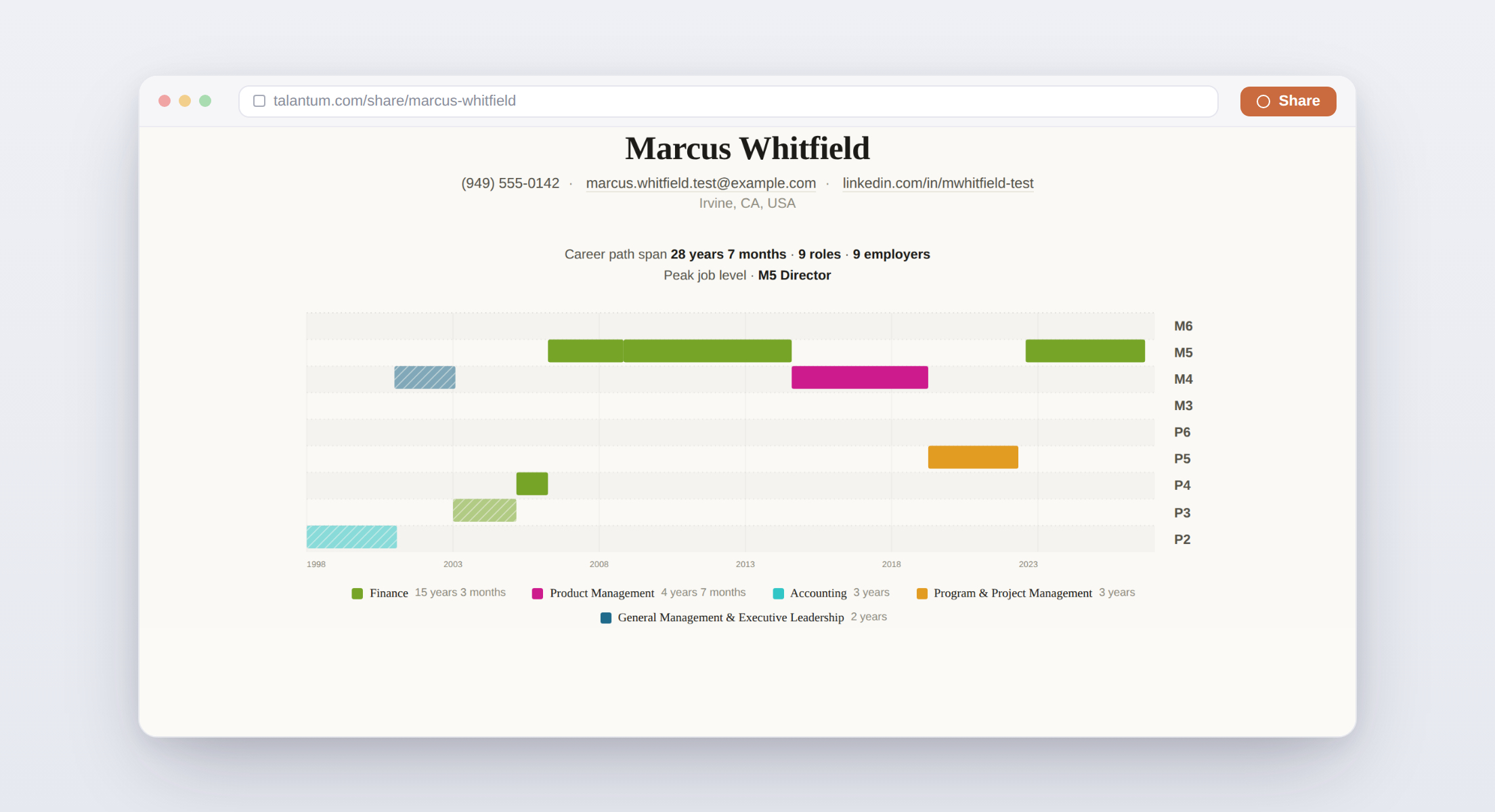
A career ladder graphic plotted every job by level and by professional sphere, so a reader could see the shape of a career at a glance, not just read about it. A pie chart showed which professional spheres actually dominated someone's experience. There were graphs for team size, budget responsibility, geography, and brand pedigree. You could compare one visual resume against a vacancy, or against another candidate's, side by side.
It worked. It was, genuinely, ahead of its time. And it hit a wall no amount of product vision could get past: turning a messy, inconsistently written resume into clean, standardized data was expensive and imprecise. Every resume uses its own language. "Manager" means something completely different at a ten-person startup than at a Fortune 500 company. Without a way to actually understand what a role's bullet points were describing, and not just what its title said, classification had to be done largely by hand, or by rules so simplistic they broke on the first edge case. That ceiling limited how far the idea could scale.
What changed
What changed is the large language model.
LLMs are what made resume parsing widely accessible in the first place: reading a paragraph of bullet points and understanding what it actually means, rather than matching keywords against a title, stopped being a research problem and became something any developer could build on. What Claude adds on top of that is a way to package the parsing and classification logic itself (the rules, the framework, the decision procedure) into a skill: a set of instructions Claude follows consistently. That is what turned "an LLM can theoretically do this" into something anyone with a Claude account can actually run, without a platform, a backend, or a team of engineers behind it.
The hard problem was never the visualization; charts are easy. It was classification: taking a paragraph of narrative bullet points and correctly determining what career level a role actually represented, independent of its title, and what functional area it actually belonged to, independent of how the candidate happened to phrase it. That is a semantic judgment, not a lookup. It requires reading and understanding, the same way a good recruiter does when evaluating a resume by hand.
Even setting classification aside, getting the visualization itself right was harder than it looked. A few other attempts came and went over the years: visualize.me and resumeup.com are the ones I remember. Most treated a resume as a single, unique story, an opportunity to turn one person's career into a fun, distinctive piece of infographic art. That is a reasonable goal, but it solves a different problem.
TalentMap was, as far as I know, the only one of these built to let a recruiter or hiring manager compare one candidate's story against another's, not just admire it in isolation. A resume that is beautifully unique is hard to put side by side with another beautifully unique resume; the visual vocabulary is different every time. A resume built on a standardized methodology is comparable by construction: two candidates rendered on the same scale, with the same color logic for the same kinds of work.
That is what opens the door beyond screening a single candidate. It is what lets you put two finalists for the same role next to each other and see the actual shape of each career, not just read two documents back to back. It is what lets you lay out a bench of internal employees during succession planning and compare their trajectories on a common footing, rather than relying on a manager's memory of who is "ready."
That is the kind of classification, judging substance over title, that was out of reach at any workable cost or accuracy for the tools I had in 2012.
I spent the last two months testing this directly: taking real and synthetic resumes, running them through an AI-driven extraction and classification process, and checking whether the output held up. Did it correctly demote a "Director" titled role that was really an individual contributor job? Did it correctly promote a "Manager" titled role that carried full P&L and hiring authority? Did the functional area weighting make sense when a role genuinely blended two disciplines? After enough rounds against enough different career profiles, I reached a point I could not reach in 2012: I could see that this works, reliably, on real career data, not just on cherry-picked examples.
What I am releasing
I am publishing that methodology as a resume parsing and visualization skill for Claude, free for personal use. It is open source on GitHub as resume-parsing-visualization.
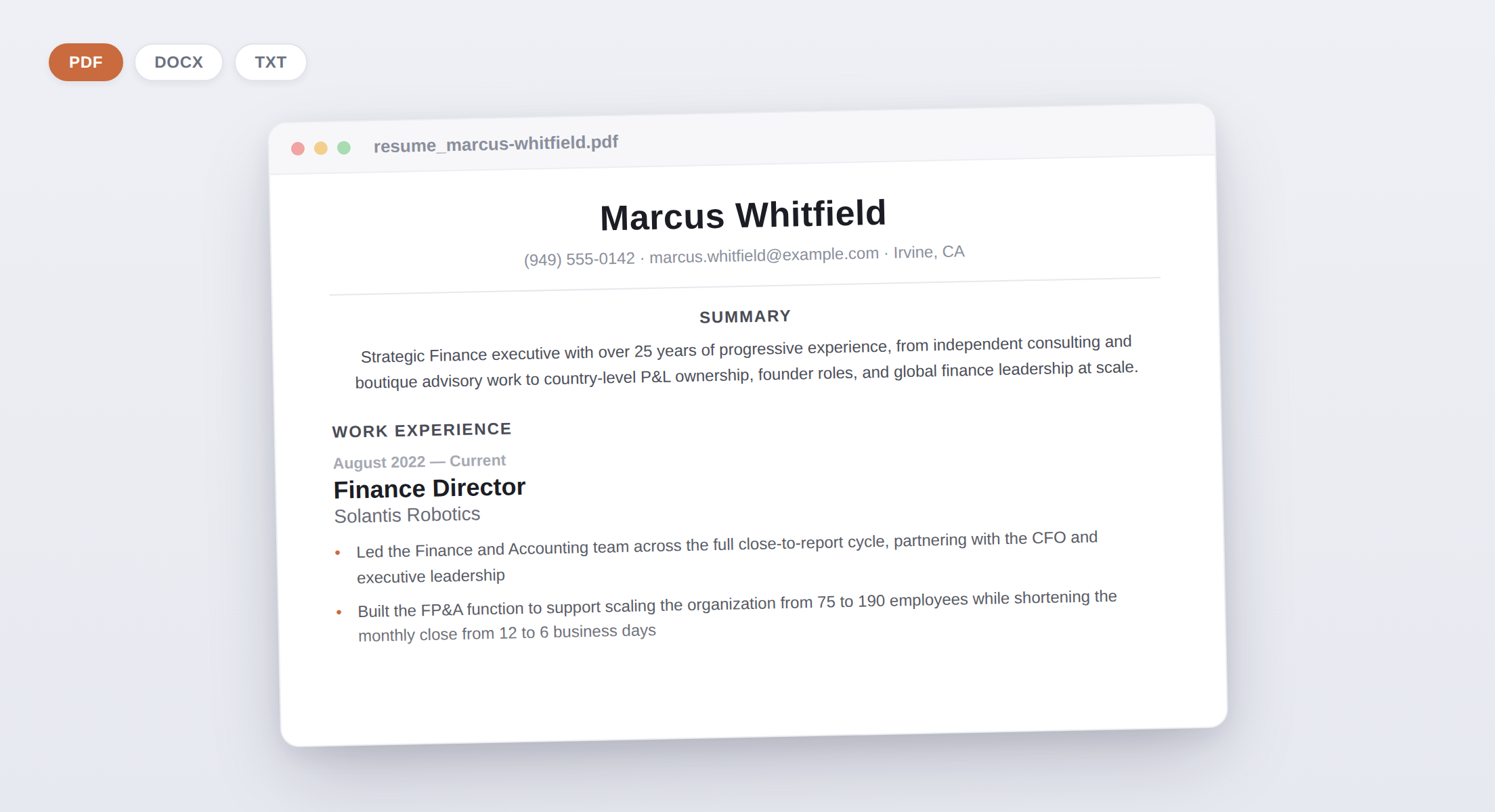
Anyone can now take their own resume and turn it into the same kind of standardized career visualization TalentMap.ru pioneered, without needing an account, a platform, or a company behind it. You get a career ladder chart rendered on a consistent visual grammar, colored by dominant professional sphere, annotated with the AI's read on your actual level at each step, alongside your original resume text, untouched and preserved.
Why this matters, beyond the novelty
The use case I care about most is the simplest one: seeing your own career clearly.
Reading your own resume rarely tells you anything new. You wrote it, you know what it says. But seeing your career as a visualized career ladder is a different kind of clarifying. It surfaces gaps you would otherwise miss, plateaus you did not realize you were in, and moments where your title undersold what you were actually doing. It shows you the shape of your own trajectory the way a stranger would see it, at a glance, before they have read a single bullet point. That is useful long before you ever apply for anything. It changes how you write your next resume, how you talk about your career in an interview, and how you think about what to do next.
There is more to this than a personal tool, though. The same standardized, comparable visualization is also the right way to show what a resume-to-job matching algorithm is doing, and it is a useful common language for recruiters and HR professionals comparing candidates or planning internal moves. Both of those deserve their own writeup, and I will get into them separately. For now, this release is about giving individuals a way to see their own career the way I first set out to show it, back in 2012.
TalentMap.ru proved the idea was right. It took an AI capable of actually reading a career, the way a person does, to make it real.
The underlying classification and visualization method is the subject of a U.S. provisional patent application filed with the USPTO (No. 64/144,139). The skill itself is free and open for personal use.

Author of the resume visualization methodology and resume-to-job matching infographic, founder of TalentMap.ru (2012)